Since passive seat belts need to be worn and released by the occupants themselves, it is not convenient to use, so people are often unwilling to use them, resulting in a low usage rate of seat belts. Since the 1970s, automobile companies such as General Motors and Ford in the United States, Volkswagen and Mercedes-Benz in Germany, and Toyota in Japan have successively developed automatic seat belts. For cars with automatic seat belts, as long as the occupant gets on the car and closes the door, the seat belt can be automatically worn on the occupant without any action by the occupant, thus greatly improving the convenience of use.
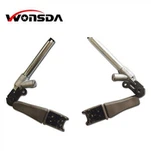
The composition of an automatic seat belt is shown in the figure. It is mainly composed of a knee belt, a waist belt, a shoulder belt, an electric motor, and an emergency lock retractor. The shoulder strap is driven by an electric motor and linked with the door switch, which greatly improves the convenience of getting on and off the car. When the door is opened, the shoulder strap can be withdrawn; when the door is closed, the upper part of the shoulder strap returns to the prescribed position of the center column, and the occupant is automatically put on the shoulder strap. The automatic seat belt itself is composed of webbing, buckle, length adjustment, sliding guide, installation accessories and retractor.
Some automatic seat belts also use microcomputer control. The gear control system confirms that the occupant's seat belts are used correctly before the engine can be started, otherwise the car cannot be started.