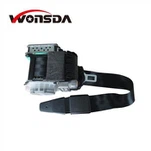
At present, the passive seat belts commonly used in automobiles are mainly composed of webbing, retractors, and mounting fixtures (accessories). The webbing is the main body of the safety belt. Synthetic fiber yarns such as nylon, polyester, vinylon, etc. are usually woven into a belt with a width of about 50mm and a thickness of about 1.5mm. It has sufficient strength, elongation performance and energy absorption performance. All countries have clear regulations on the technical performance index of webbing, and it can be used only if it meets the regulations.
The function of the retractor is to store the webbing and lock the webbing to be pulled out. It is the most complicated mechanical part of the safety belt. In the initial retractor, there was a ratchet mechanism. Once the webbing is continuously pulled out from the winding process, the ratchet mechanism will lock it to prevent the vehicle maintenance webbing from being pulled out, so that the seat belt will not automatically relax. After the mid-1970s, there has been a retractor that can automatically lock the webbing when the vehicle encounters an emergency, and under normal circumstances, the occupant can move freely on the seat. This is also the most commonly used seat belt retractor.
The mounting fixtures are lugs, plug-ins, bolts, etc. connected to the car body or seat components. The installation position and firmness of these components directly affect the protective effect of the seat belt and the comfort of the occupants. The installation location and installation standards of the fixed parts are also clearly stipulated.