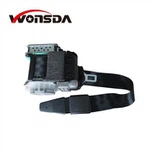
(1) Webbing Webbing is a belt with a width of about 50mm and a thickness of about 1.2mm woven with synthetic fibers such as nylon or polyester. According to different uses, the strength and elongation required by the seat belt are achieved through weaving methods and heat treatment. And other characteristics. It is also the part that absorbs conflict energy. National laws and regulations have different requirements for the performance of seat belts.
(2) The retractor is a device that adjusts the length of the seat belt according to the sitting posture and figure of the occupant, and rewinds the webbing when not in use.
Divided into ELR (Emergency Locking Retractor) and ALR (Automatic Locking Retractor).
(3) Fixing mechanism The fixing mechanism includes buckle, lock tongue, fixed pin and fixed seat. Buckles and bolts are devices that fasten and release seat belts. The one that fixes one end of the webbing to the car body is called a fixing plate, the fixed end of the car body is called a fixing seat, and the fixing bolt is called a fixing bolt. The position of the shoulder belt fixing pin has a great influence on the convenience of wearing a seat belt. Therefore, in order to suit passengers of various sizes, an adjustable fixing mechanism is generally used to adjust the position of the shoulder belt up and down.